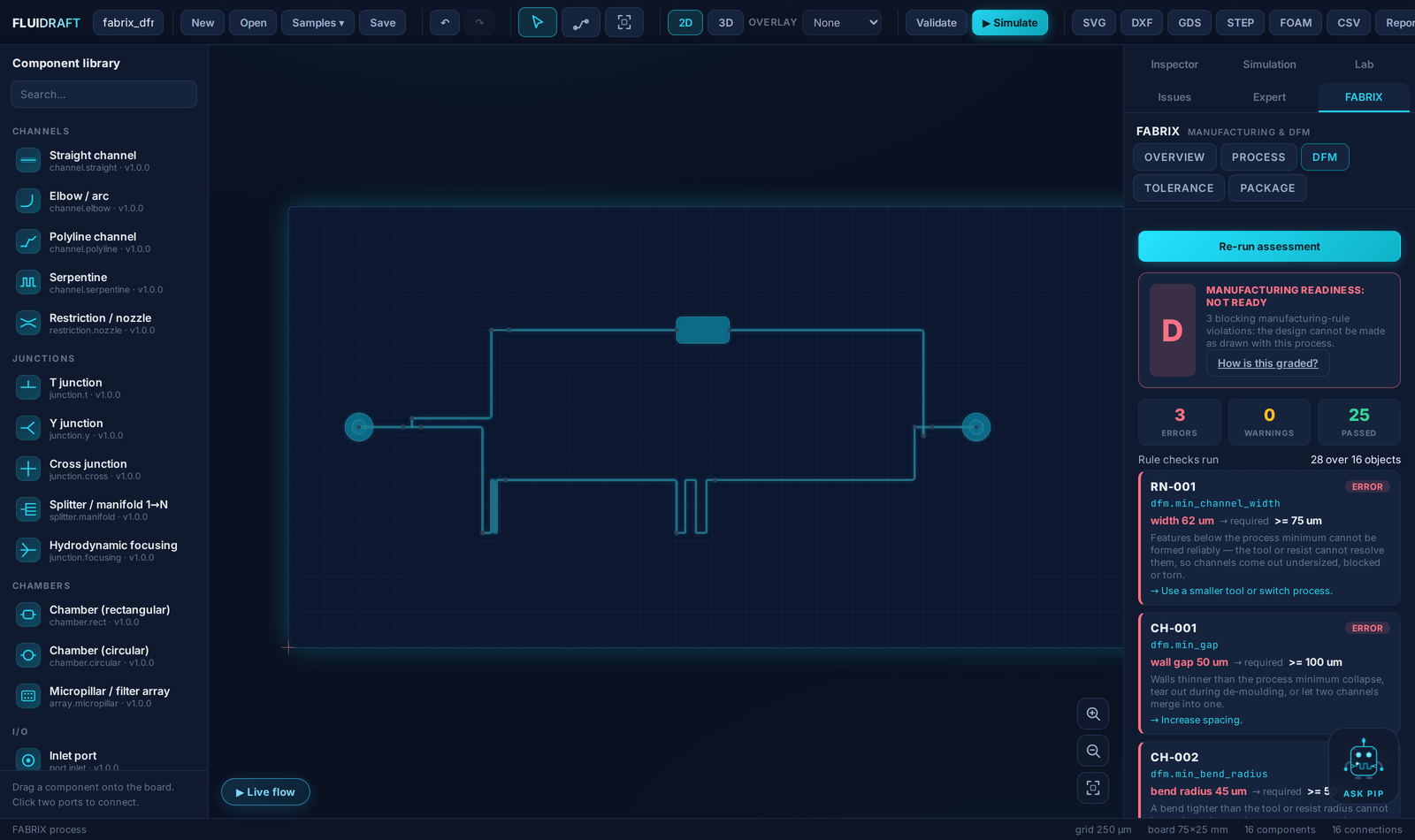
Fluidraft tells you how your design will behave. FABRIX tells you whether it can be fabricated: pick a manufacturing process, get object-level design-for-manufacturing findings on the live design — the 62 µm channel that a 75 µm end-mill can't cut, the wall that will tear out, the bend tighter than the tool — fix them in place, re-analyse to READY, then hand the shop one coherent manufacturing package.
FABRIX is a paid module inside Fluidraft — same project, same canvas, same objects; nothing is imported or duplicated. In the browser demo it appears in its locked preview; in an unlicensed Fluidraft install it runs fully, with watermarked outputs, so you can evaluate it before buying.
FABRIX is an orchestration layer over Fluidraft's own engines — the same design rules the Issues panel checks, the same Monte-Carlo tolerance engine, the same exporters. It never keeps a second copy of your geometry, so a finding always points at the real object.
Choose from the shipped fabrication profiles — PDMS soft lithography, CNC thermoplastic, hot embossing, glass wet etch, SLA/DLP — each with its design rules, its version, and an indicative process tolerance, all labeled GENERIC / INDICATIVE, never manufacturer-certified.
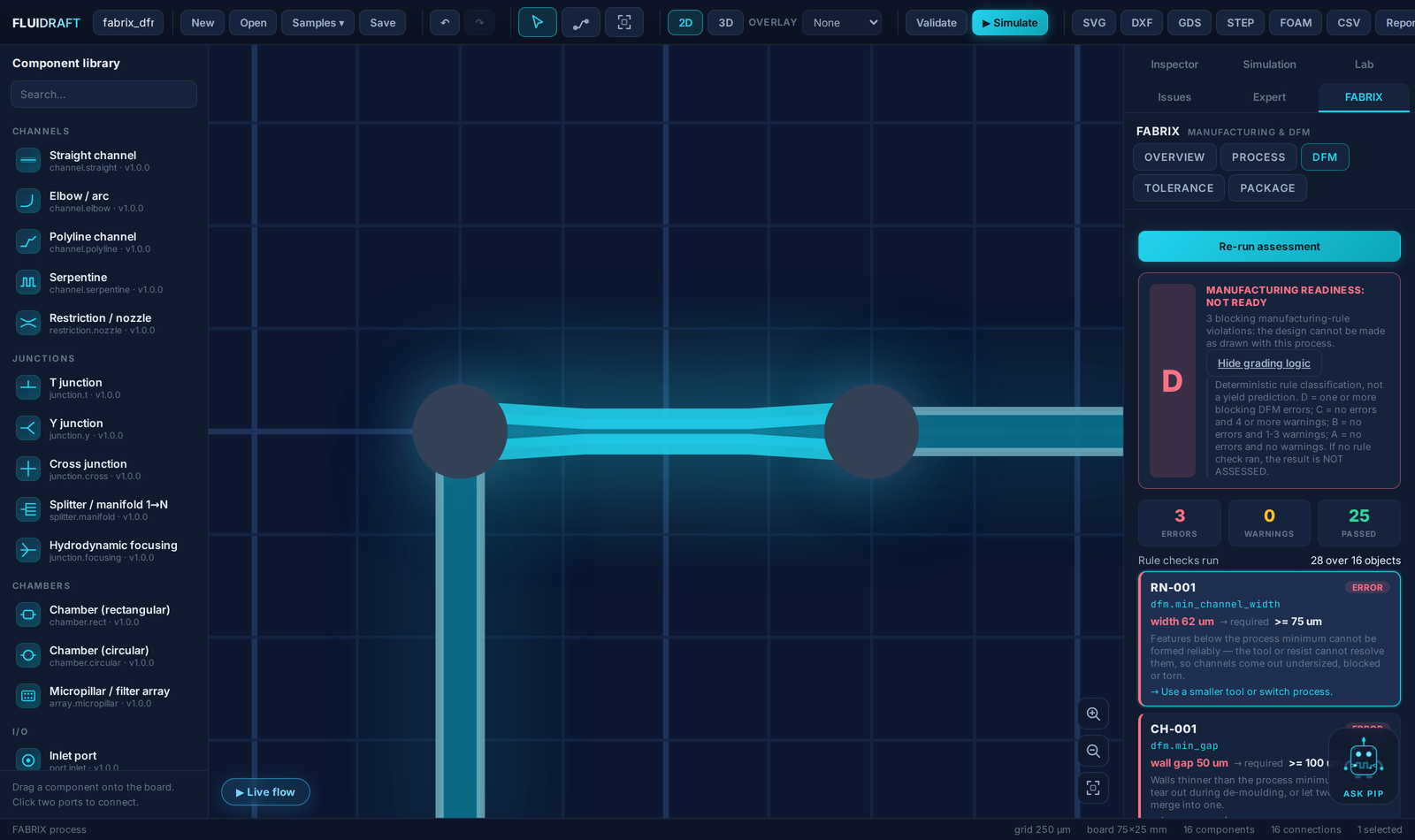
Deterministic rule findings per engineering object: rule id, current value, the process limit, why it matters physically, and what to change. Click a finding and the canvas zooms to the offending feature; fix it in the Inspector; re-analyse. The verdict visibly expires the moment the design changes.
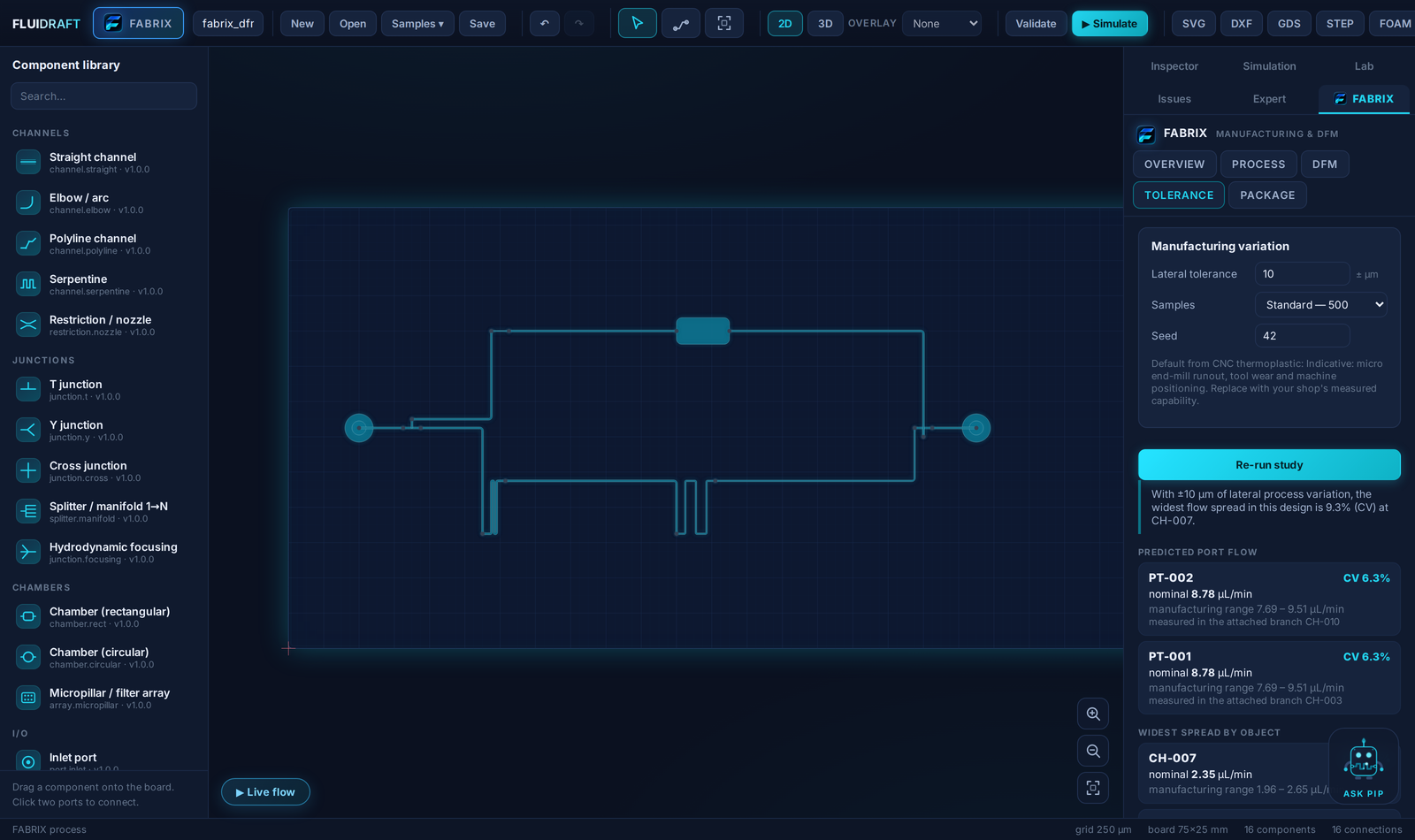
The existing Monte-Carlo engine, asked a manufacturing question: with ±X µm of lateral process variation, every branch flow becomes a range. Per-object and per-port results in µL/min, plus a ranked list of which dimension drives the spread — so you tighten the one that counts.
One zip: geometry (SVG, DXF, GDSII, STEP), the device specification and the canonical project file, a self-contained DFM report, the tolerance study as CSV, the full rule profile, and a reproducibility stamp. Anything that couldn't be produced is listed in the manifest with its reason — a gap in a hand-off is a question the shop shouldn't have to ask.
FABRIX classifies rule violations. It does not predict production yield, and it will not until there are validated manufacturing datasets to build such a prediction on. The grading logic is printed in the product, in every payload, and here:
FABRIX is a subscription add-on to your Fluidraft plan — $49/month, or $490/year with two months free — and is carried by the same signed licence file. Letting it lapse never breaks Fluidraft — or your saved manufacturing settings, which stay untouched in the project file and come back the moment you renew. The full suite (Core + all three modules) is $189/month or $1,890/year.
Licence file by e-mail after checkout · academic 50%: write from your institution
Base Fluidraft never depends on FABRIX: design, simulation, exports and your project files work identically without it. A project that carries FABRIX settings opens unchanged on an unlicensed install — module data is preserved, never deleted.